


TL;DR
Oman has roughly 47 international schools, concentrated heavily in Muscat, with smaller clusters in Sohar and Salalah. Five curricula dominate: British (IGCSE/A-Level), International Baccalaureate (IB), Indian CBSE, American (HSD/AP) and bilingual Omani-international hybrids. Annual fees span a 20× range — from OMR 264 at Bangladesh School Muscat to OMR 10,270 at TAISM, currently Oman's most expensive school. All private schools must teach Arabic and Islamic Studies under Royal Decree 31/2023. Top schools have 6–12 month waiting lists. Fees outside Muscat run 30–50% lower than in the capital.
Quick stats
- 47+ international schools verified across Oman, with 21 listed in Muscat alone (Oman Observer)
- OMR 264 – 10,270 annual fee range across all curricula, the widest in the GCC
- 140,000+ students in Oman's private K-12 sector, around 23% of all students (MoE figures cited in K-12 Schools in Oman research compilation)
- 7 IB World Schools authorized in Oman, including 3 running the full PYP/MYP/DP Continuum (IB Organization)
What counts as an "international school" in Oman?
Most parents searching for an international school in Oman quickly hit a wall: every list defines the term differently. Some count any English-medium private school. Others count only the elite British and American campuses. The Ministry of Education doesn't make a hard distinction — it licenses everything under one private-school category and leaves "international" as a marketing label.
We use a working definition that actually helps you choose.
The OSF definition (and why it matters)
For us, an international school in Oman meets four criteria: it follows a foreign curriculum (British, American, IB, French, Indian CBSE, etc.), instruction is primarily in English or another non-Arabic language, the student is multinational, and the school is MoE-licensed. That's it. Of Oman's 1,200 private schools and kindergartens educating over 140,000 students in 2024/25, only a fraction meet all four tests. Most of the 1,200 are bilingual schools serving Omani families with the national curriculum.
Did you know
Approximately 72% of students in the private K-12 sector are Omani nationals, reflecting a growing preference for private and bilingual curricula over the public system.
Why definitions matter — most online lists conflate "international," "private," and "community" schools and quietly inflate their counts. We don't. A school teaching the Omani national curriculum in Arabic with some English support is a private school, not an international one — even if its name says otherwise.
How many international schools does Oman actually have?
Around 35 to 47, depending on how strictly you draw the line. Our own directory tracks every MoE-licensed school in the country, and when we filter by curriculum and medium of instruction, the true international count lands in the high 30s — clustered overwhelmingly in Muscat, with single-digit counts in Sohar and Salalah.
Enrollment figure
Specifically, there are 63,974 students enrolled in the 47 foreign community schools for the 2024–2025 year.
Who attends these schools?
The student body splits into three groups, each headed for a different kind of school. Expat children from India, Bangladesh, and Pakistan — the largest foreign communities, around 1.45 million people combined out of Oman's 5.49 million residents — overwhelmingly attend community schools following CBSE, FBISE, or Edexcel curricula. Western expats, diplomats, and globally mobile professionals fill the premium international schools: ABA Oman International School draws students from 75 nationalities into a body of roughly 920; TAISM serves about 600. The third group — affluent Omani families — is rising fast, and increasingly choosing IB and British curriculum schools over the bilingual hybrids their parents picked.
The real numbers
The math doesn't add up the way most guides imply. Combined expatriate communities in Oman include hundreds of thousands of school-age children, but the entire private K-12 sector — community schools included — educates only 233,000 students total. A large share of expat children either attend government schools (now permitted under Royal Decree 31/2023), are homeschooled, or live without dependents. Premium international schools serve a tiny, self-selecting slice: the diplomatic corps, oil-and-gas executives, and a growing class of Omanis who can absorb OMR 8,000+ annual fees. That's why waiting lists at BSM and TAISM persist even as overall expat numbers drop.
The curriculum landscape: British, American, IB, Indian, bilingual & beyond
Five curricula dominate Oman's international schools: British (IGCSE/A-Level), American (HSD/AP), International Baccalaureate (IB), Indian CBSE, and bilingual Omani-international hybrids. A handful of niche options — French, SABIS, Finnish, Pakistani, Filipino, Bangladeshi, Sri Lankan — fill specific community needs. Which one fits depends less on which is "best" and more on where your child will study after Grade 12.
British Curriculum (IGCSE & A-Levels)
The British pathway is Oman's most populous international curriculum. Schools follow the National Curriculum of England, leading to IGCSEs at the end of Grade 10 or 11 and A-Levels at Grade 12 or 13. British School Muscat is the flagship — over 50 years of operation, "outstanding" BSO inspection ratings, fees from OMR 3,800 in Foundation to OMR 9,200 in Year 13. Newer entrants raise the ceiling: Cheltenham Muscat opened in 2021 as a UK Cheltenham College franchise, and Downe House Muscat opened in 2022 as the only British all-girls school in Oman. Knowledge Gate International School (KGIS) is the only Oman school in the global Inspired group of 110+ premium schools. Other strong options: Muscat International School by Amity, Gulf International School, and British School Salalah — the only British school outside Muscat. A-Levels are accepted by every UK university and around 600 US universities including all the Ivy League, per Crimson Global Academy.
American Curriculum (HSD/AP)
The American track is narrower in Oman but anchored by one of the country's most established schools. The American International School of Muscat (TAISM) — founded in 1998 on land donated by the late Sultan Qaboos, US-accredited, ~600 students — runs a full Pre-K to Grade 12 American program with AP courses, ending in a US high school diploma. Tuition runs from OMR 5,150 in early childhood to OMR 10,270 in Grade 12, currently the highest published fees in the country. American International School Salalah extends the curriculum southward at a smaller scale and lower price point. Beyond TAISM and AIS Salalah, the American label gets fuzzier — Modern International School (MISO) switched from CBSE-International to American curriculum in 2017, and several newer Muscat schools (Al-Roya, Future International, American Lyceum) offer American-style programs of varying depth. AP is recognized by universities in over 60 countries, per the College Board, with the strongest recognition in the US and Canada.
International Baccalaureate (IB)
Oman has seven IB World Schools — the most-searched curriculum category in our directory by a wide margin. The full Continuum (PYP, MYP, DP) is offered at three: ABA Oman International School in Muscat, Al Batinah International School (ABIS) in Sohar — the only IB school in North Al Batinah — and Al Sahwa Schools, Oman's only bilingual three-program IB school. Ellesmere Muscat (formerly Alruwad International School) also runs the Continuum. The Diploma Programme alone is offered at The Sultan's School alongside its bilingual track. MySchool Oman and OurPlanet International School hold PYP authorization for the early years. ABA's IB Diploma results are exceptional — the school has produced two perfect 45/45 scores (Class of 2020 and Class of 2021), and Diploma pass rates routinely exceed world averages. The IB carries weight everywhere: an IB score of 38 equates to AAA* at A-Level on the UCAS tariff per TutorChase, and HESA data shows IB graduates are more likely to achieve first-class honours than A-Level peers.
Want IB everywhere? Only ABA, ABIS Sohar, and Al Sahwa offer all three IB programmes (PYP, MYP, DP) in Oman. The Sultan's School offers DP only. Two schools — MySchool and OurPlanet — currently teach PYP only.
Indian Curriculum (CBSE)
Oman's Indian Schools network is the largest single curriculum group in the country by enrollment. Over 20 schools run under the Board of Directors of Indian Schools, collectively educating roughly 50,000 students — a number larger than the entire premium-international sector combined. Indian School Muscat (Darsait) alone enrolls over 9,000 students. Fees are an order of magnitude below the British and American schools: ISM charges around OMR 546 in KG rising to OMR 617 in Grade 12, and Indian School Al Wadi Al Kabir runs OMR 504 in primary to roughly OMR 750 at senior secondary. The network extends across the country — Indian School Al Ghubra, Indian School Sohar, Indian School Salalah, Indian School Nizwa — making CBSE the only international curriculum genuinely available outside Muscat at scale.
Bilingual & Hybrid Schools (Omani + International)
This is the category most online lists miss, and it's arguably Oman's most distinctive offering. Bilingual schools combine the Omani national curriculum with an international program — usually Cambridge IGCSE/A-Level or IB — taught across both Arabic and English. The Sultan's School is the prestige anchor: founded by the late Sultan Qaboos, IB Diploma option in senior years, fees OMR 2,690 (KG) to OMR 5,420 (Grade 12). Al Sahwa Schools layer the IB Continuum onto a bilingual base, fees OMR 2,160 to OMR 4,700. Azzan Bin Qais International School (ABQ) runs Cambridge IGCSE alongside the Omani program at OMR 2,150 to OMR 4,950. KGIS is unusual: it offers parents a choice between a pure British stream and an Omani Bilingual GED stream within the same school. Ahmad bin Majid and Al Shomoukh International round out the category.
Why bilingual schools dominate Omani family choice
Bilingual schools are where most affluent Omani families actually send their children — not the elite British and American schools that dominate every "best schools in Oman" listicle. The reason is structural: bilingual programs preserve Arabic fluency and Islamic studies depth at a level the Ministry of Education recognizes for local university admission and government scholarships, while still delivering IGCSE or IB credentials for international options. A child graduating from BSM or TAISM has a US/UK pathway but a harder time qualifying for Sultan Qaboos University or a Diwan scholarship. A child graduating from The Sultan's School or Al Sahwa keeps both doors open. This is why Sultan's School and Al Sahwa fees keep climbing despite being technically "private bilingual" rather than "international" — demand from local families exceeds capacity.
Other curricula (French, SABIS, Finnish, Pakistani, Filipino, Bangladeshi, Sri Lankan)
The remaining curricula serve specific communities at modest scale. Lycée Français de Mascate runs the French Ministry of Education program from maternelle to Baccalauréat, fees roughly OMR 2,650 to OMR 5,310. The International School of Choueifat – Muscat uses the proprietary SABIS system. Finland Oman School blends Finnish pedagogy at OMR 3,000 to OMR 6,240. The community-curriculum schools are budget-tier: Pakistan School Muscat charges roughly OMR 300 to OMR 500 a year on the FBISE board, Bangladesh School Muscat runs Edexcel IGCSE/A-Level at OMR 264 to OMR 550, Philippine School Muscat follows the DepEd curriculum, and Sri Lankan School Muscat prepares students for London O/A Levels at around OMR 75 to OMR 110 monthly.
International school fees in Oman (2026)
International school fees in Oman span a wide range — from roughly OMR 500 a year at community Indian schools to OMR 10,270 at TAISM, currently the country's most expensive school. Premium British, American, and IB schools in Muscat cluster between OMR 4,000 and OMR 10,000+ at the senior grades. Mid-tier bilingual schools sit between OMR 2,000 and OMR 5,000. The cheapest options — Pakistani, Bangladeshi, Indian community schools — stay under OMR 1,000 a year. For a deeper breakdown of all school types, see our complete school fees guide.
The fee map at a glance
The full Oman fee distribution covers a 20× spread. Indian, Pakistani, and Bangladeshi community schools — the largest by enrollment — charge between OMR 264 and OMR 750 annually. Premium British and IB schools start around OMR 3,000 in early years and climb to OMR 9,000+ by Grade 12. American curriculum is the priciest, anchored by TAISM at OMR 10,270. The Ministry of Education sets the regulatory floor: in 2023 it halved the per-student private school license fee from OMR 300 to OMR 150 and the school license renewal from OMR 1,500 to OMR 750, per Muscat Daily — modest savings that schools rarely pass to parents.
Premium tier (OMR 5,000–10,000+)
The premium tier is small — fewer than ten schools — but it sets the price ceiling for the entire country. TAISM is the most expensive: OMR 5,150 in Pre-K rising to OMR 10,270 in Grade 12, the only school in Oman that consistently breaks five figures across multiple grade bands. British School Muscat charges OMR 3,800 in Foundation Stage, climbing to OMR 9,200 in Year 13 — but new entrants also pay an OMR 2,700 development fee spread over the first 3 years per BSM's published fees, plus an OMR 50 assessment fee and OMR 300 reservation fee. ABA Oman International School runs OMR 4,620 at KG to OMR 9,340 in Grades 11–12, with a one-time OMR 3,000 building fee on top. Cheltenham Muscat and Downe House Muscat — both opened post-2021 — sit just below: Cheltenham at OMR 3,785 to OMR 7,875, Downe House at OMR 4,750 to OMR 7,500. KGIS and the International School of Oman round out the premium grouping.
The hidden first-year premium
At the top of the market, the gap between published tuition and total first-year cost is wider than parents realize. A new Year 7 student at BSM doesn't pay OMR 7,500 — they pay closer to OMR 11,000 once you add the OMR 2,700 development fee (paid OMR 300 per term over 9 terms), OMR 300 reservation fee, OMR 50 assessment, transport (~OMR 500), books, uniform, and the first IGCSE-prep fees. ABA's OMR 3,000 building fee and TAISM's enrollment fees behave similarly. Most fee comparison sites quote only the headline tuition and hide the 15–25% premium baked into the entry year — which is exactly why parents end up shocked at the first invoice.
Mid-tier (OMR 2,000–5,000)
The mid-tier is where most affluent Omani families and budget-conscious expats actually land. The Sultan's School runs OMR 2,690 in KG to OMR 5,420 in Grade 12 — exceptional value given its IB Diploma option and bilingual depth. Al Sahwa Schools charges OMR 2,160 to OMR 4,700 across the IB Continuum. Azzan Bin Qais (ABQ) sits at OMR 2,150 to OMR 4,950 with Cambridge IGCSE. Al Injaz Private School is more affordable still at OMR 1,822 to OMR 3,322. KGIS bridges the mid and premium tiers depending on stream selected. Lycée Français de Mascate lands here too, OMR 2,650 in maternelle to OMR 5,310 in lycée — French government subsidies keep fees below what a comparable Anglophone school would charge.
Budget tier (OMR 500–2,000)
This is the largest tier by student headcount and the most invisible in English-language guides. Indian School Muscat charges roughly OMR 546 in KG to OMR 617 in Grade 12 — an entire year of CBSE education for less than one month at TAISM. Indian School Al Wadi Al Kabir runs OMR 504 to OMR 750. Pakistan School Muscat is even cheaper — OMR 300 to OMR 500 a year, subsidized by the Pakistani community and embassy. Bangladesh School Muscat charges OMR 264 in primary to OMR 550 at A-Level, while running an actual Edexcel IGCSE/A-Level program — arguably the best fee-to-curriculum ratio in the country. Philippine School Muscat sits around OMR 400 to OMR 600. These schools manage low fees through large class sizes, community-funded operations, and modest facilities.
How fees compare across Oman's regions
Fees outside Muscat run 30–50% lower for the same curriculum. British School Salalah charges OMR 1,750 in FS1 to OMR 4,200 in Year 12 — less than half BSM's senior-year tuition for the same British curriculum. Al Batinah International School (ABIS) in Sohar runs OMR 3,100 to OMR 7,800 across the IB Continuum, well below ABA's range despite identical IB World School authorization. The pattern holds across all curricula: lower local incomes, smaller expat populations, and lower operating costs let regional schools price more accessibly. The trade-off is choice — Sohar has fewer than five international schools, Salalah has roughly the same.
How Oman compares to Dubai, Riyadh, and Doha
Oman is the cheapest GCC country for international schooling. Per Mirabello Consultancy's 2026 Oman education report, international school fees in Muscat range from OMR 1,500 to OMR 8,000+ (USD 3,900 to USD 20,800) — meaningfully below Dubai equivalents, where premium British and American schools regularly exceed AED 90,000 (~OMR 9,400) and frequently top AED 120,000+ for senior grades. Doha and Riyadh fall between the two. The same UK or US curriculum costs less in Muscat than at the same brand's Dubai or Doha sister campus — which is why Oman is increasingly attractive for regionally mobile expat families with school-age children.
Hidden costs every parent should budget for
Tuition is the headline. It's also rarely the full bill. Across the schools we track, the realistic first-year cost runs 10–20% above quoted tuition at premium schools, and even community schools tack on registration, deposits, and transport fees that can quietly add OMR 200–500 to the year. Here's what to actually budget for.
The first-year premium
The first year is always the most expensive — by a meaningful margin. Premium schools layer one-time fees on top of tuition that don't recur in subsequent years. British School Muscat charges an OMR 50 assessment fee for new applicants, an OMR 300 reservation fee per child, and a development fee of OMR 300 per term across 9 terms — OMR 2,700 total per BSM's published fees. ABA Oman International School levies a one-time OMR 3,000 building fee. KGIS requires OMR 300 non-refundable registration. Mid-tier schools are gentler — Al Injaz charges OMR 175 — but the pattern is universal.
First-year cost can run OMR 1,500–3,000+ above quoted tuition at premium schools. Always ask for a written total-cost breakdown before signing.
Recurring extras (transport, exams, books, uniforms)
These are the costs that hit every September, not just the first one. School bus fees typically run around OMR 500 a year for a Muscat route — sometimes more for routes outside Muscat or for premium schools with branded transport. Books and uniforms add another OMR 200–500 depending on grade and curriculum: IB Diploma textbooks alone can run OMR 100+ per year, while Indian schools using local-edition CBSE books rarely exceed OMR 50. External exam fees are the biggest hidden line item at the senior end — KGIS publishes IGCSE/A-Level/IB exam fees of roughly OMR 250–300 for Grade 4 to 12 students, and most British and IB schools charge similar amounts in Year 11 and Year 13. Some schools also tack on technology or program fees: KGIS lists an "AI & VR fee" of OMR 21–42 by grade. Late payment fines run roughly OMR 1 per week or month of delay across most private schools — small individually, painful if missed repeatedly.
Refundable deposits and re-registration
Two recurring costs most parents forget. Many schools take a refundable security deposit at admission — Indian School Muscat charges OMR 100 for the first child and OMR 10 for each additional sibling per ISM's published structure. International schools usually fold this into a non-refundable enrollment fee instead. Re-registration fees apply to existing students reserving next year's seat: Al Sahwa Schools charges OMR 200 per year to continuing families, sometimes deducted from next term's tuition, sometimes forfeit if the child doesn't return.
Discounts you should ask about
Most schools offer sibling discounts but rarely advertise them prominently. The typical structure is 5% off the second child's tuition and 10% off the third — Assafwah International School and several mid-tier schools follow this pattern. ABA gives a sibling rebate on the enrollment fee specifically: 5% for the second child, 10% for the third and beyond. Some schools — particularly newer ones competing for enrollment — offer a small early-payment discount of OMR 100–200 for parents who pay the full annual fee upfront at the start of the year.
Ask before you sign
These discounts are almost never published on school websites or fee sheets. They live in the admissions team's discretionary toolkit, applied case-by-case to families they want to retain. Always ask explicitly during the offer stage — once you've signed and paid term one, your leverage drops to zero.
Schools by location
International schooling in Oman is concentrated heavily in Muscat. Roughly 80% of the schools meeting our international criteria — foreign curriculum, English medium, multinational student body — operate within the capital governorate. Sohar and Salalah have small but credible clusters. The interior governorates (Dakhiliyah, Sharqiyah, Wusta, Buraimi, Musandam) are thin: a handful of Indian community schools and limited international options.
Muscat: where the international schools cluster
Muscat is Oman's school capital. The governorate hosts around 797,000 residents and, per Global Media Insight, over 758,000 expatriates as of recent NCSI data. That density of foreign professionals and globally mobile families pulls schools into specific neighborhoods, not spread evenly across the city. Madinat Qaboos is the historical core: British School Muscat and ABA Oman International School sit within walking distance of each other. TAISM is in Ghala, on land donated by the late Sultan Qaboos in 1998. The newer premium British schools cluster in Al Bandar, the master-planned development on Muscat's coast — Cheltenham Muscat and Downe House Muscat both opened there post-2021. KGIS is in Al Hail South, near Mabela, anchoring Muscat's western expansion. The Indian schools are scattered — Darsait, Al Ghubra, Al Wadi Al Kabir — historically tracking where Indian communities settled. New schools are opening in Knowledge Oasis Muscat (KOM): Jebel View International School launches there in September 2026.
Sohar & North Al Batinah
Sohar is Oman's second school hub, driven by the industrial expat workforce at Sohar Port and Sohar Aluminium. North Al Batinah governorate has 212 private schools and kindergartens as of 2024/25, but the truly international set is small. Al Batinah International School (ABIS) is the anchor — TAISM-managed, owned by Sohar Aluminium and Orpic, and the only IB World School in the region running the full PYP/MYP/DP Continuum. Fees run OMR 3,100 in KG to OMR 7,800 in Grade 11/12. Beyond ABIS, families rely on Indian School Sohar, Sohar International School, and a handful of bilingual options.
Salalah & Dhofar
Dhofar has 227 schools total — 166 government and 61 private, spread across a large geographic area. Salalah city is where the international options live. British School Salalah is the only British curriculum school in the south, charging OMR 1,750 in FS1 to OMR 4,200 in Year 12 — less than half BSM's fees. American International School Salalah operates at smaller scale with American-style programming. The community schools serve their respective populations: Indian School Salalah, Pakistan School Salalah, and a Bangladesh School branch.
Nizwa, Sur, Duqm and other regions
Outside Muscat, Sohar, and Salalah, international schooling thins out fast. Nizwa has Indian School Nizwa and a handful of bilingual private schools — but no British, American, or IB option. Sur, Ibri, and Buraimi are similar: a few private schools, mostly Omani-bilingual or local CBSE branches. Duqm — Oman's emerging industrial zone — has government schools and an Indian School branch, but international families relocating for SEZ projects often weekly-board their children in Muscat or homeschool.
Relocating outside Muscat?
If you're being relocated to Duqm, Sur, or any interior governorate, factor schooling into your offer negotiation upfront. We've seen multiple expat families take posts in these regions assuming international options exist locally, then discover after arrival that the only path is Muscat boarding or relocation. Some employers will cover the gap; many won't unless you ask before signing.
Out-of-Muscat schooling: cost vs. choice
The trade-off outside Muscat is consistent: lower fees, fewer options. British School Salalah at OMR 4,200 in Year 12 is less than half BSM's senior tuition for the same curriculum. ABIS Sohar at OMR 7,800 is meaningfully below ABA's OMR 9,340 despite identical IB authorization. The savings are real — typically 30–50% across comparable curricula. But your child has one or two viable options instead of ten, and switching schools mid-year if the fit doesn't work means relocating the family or accepting a long commute. For long-term residents, regional schooling is often a better deal than Muscat. For newly arriving expats unsure of fit, Muscat's optionality is worth the premium.
The top international schools in Oman
These eleven schools account for the majority of premium international enrollment in Oman and the schools parents most often shortlist. We've ordered them by category — established premium first, newer entrants next, bilingual and IB-focused, then regional and community benchmarks — not by ranking. There is no objective "best" school in Oman; there's only the best fit for your child, your curriculum needs, and your budget.
British School Muscat (BSM)
The benchmark British curriculum school in Oman, and the one most other schools are measured against. BSM has operated for over 50 years and was rated outstanding in all categories by British Schools Overseas inspectors. Its IGCSE and A-Level results consistently place it in the top 3% of UK state schools and top 9% of UK independent schools per Spear's 500. Tuition runs OMR 3,800 in Foundation Stage to OMR 9,200 in Year 13, with a one-time OMR 2,700 development fee for new entrants paid OMR 300 per term over 9 terms, plus an OMR 50 assessment fee. The school has 10 art and science labs, a sports centre with three pools, and a 500-seat theatre. Waiting lists are common — we've seen families apply 12+ months in advance for KG1 spots. Located in Madinat Qaboos, near the diplomatic quarter.
Curriculum: British (IGCSE/A-Level + IB Diploma alongside) · Ages: 3–18 · Founded: 1971 · Location: Madinat Qaboos, Muscat

American International School of Muscat (TAISM)
The only school in Oman offering a pure American curriculum from Pre-K through Grade 12, ending in a US high school diploma with AP courses. Founded in 1998 on land donated by the late Sultan Qaboos, TAISM serves around 600 students from the US embassy community, corporate expats, and local Omani families wanting an American-style education. The Ghala campus is the largest international school site in Muscat and includes two photovoltaic farms producing roughly 8.2% of campus electricity. Fees run OMR 5,150 in Pre-K to OMR 10,270 in Grade 12 — currently the highest published tuition in Oman. TAISM publishes a 2025 Special Needs Profile through the US State Department's Office of Overseas Schools, one of only a few Oman schools with formal SEN documentation. US-accredited, AP-endorsed.
Curriculum: American (HSD + AP) · Ages: 3–18 · Founded: 1998 · Location: Ghala, Muscat

ABA Oman International School
The leading IB school in Oman and one of the most diverse — students from 70+ nationalities (75 by some counts) across roughly 920 enrolled. Founded in 1987 as the American-British Academy, ABA is the first school in the region to offer all three IB programmes — PYP, MYP, and DP. The Class of 2020 and Class of 2021 each produced a perfect 45/45 IB Diploma score, a distinction shared by only a handful of IB schools globally. ABA opened a new purpose-built campus in Madinat Al Irfan in 2022. Fees run OMR 4,620 at KG to OMR 9,340 in Grades 11–12, with a one-time OMR 3,000 building fee. The school is CIS-accredited and known for an inquiry-based pedagogy aligned with IB philosophy. Many diplomatic and international organization families choose ABA specifically for the Continuum.
Curriculum: IB (PYP/MYP/DP) · Ages: 3–18 · Founded: 1987 · Location: Madinat Al Irfan, Muscat
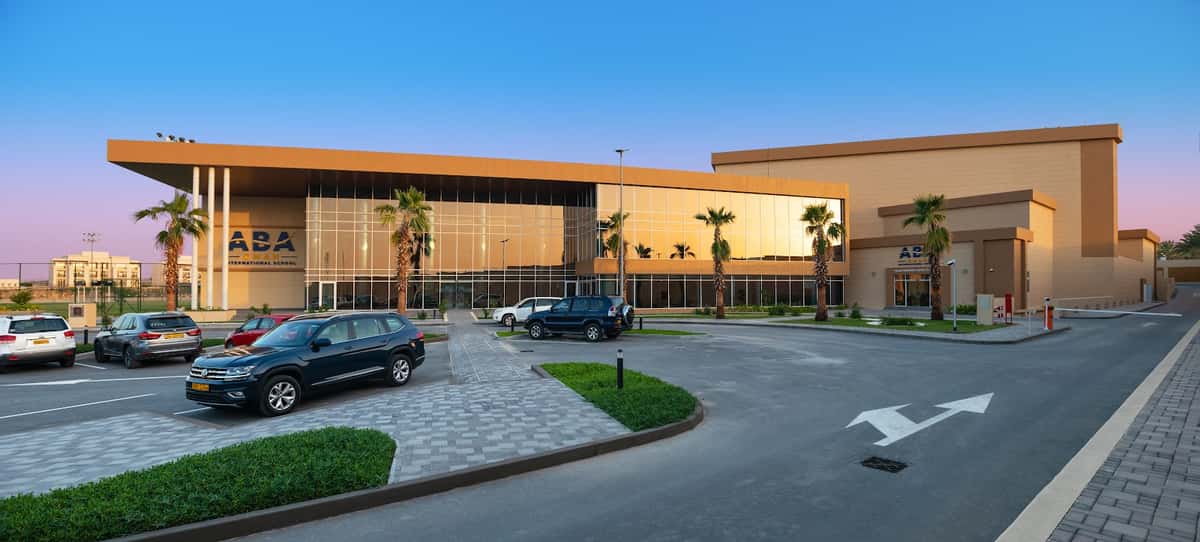
Cheltenham Muscat
Oman's first premium UK boarding-school franchise, opened in 2021 as a sister campus to Cheltenham College in the UK, which has 180+ years of educational heritage. Cheltenham Muscat runs the British curriculum (Prep & Senior phases) for boys and girls aged 4 to 18. Fees run OMR 3,785 in KG to OMR 7,875 in Year 11 — meaningfully below BSM at the senior end while offering similar facilities and brand pedigree. Located in Al Bandar on Muscat's coast, alongside Downe House. Day school only (no boarding currently offered in Oman).
Curriculum: British (Cambridge IGCSE/A-Level) · Ages: 4–18 · Founded: 2021 (UK parent: 1841) · Location: Al Bandar, Muscat

Downe House Muscat
The only British all-girls school in Oman. Opened in 2022 as a branch of Downe House in the UK, which has educated girls for over a century. Fees run OMR 4,750 in Year 4 to OMR 7,500 in Year 13. The school sits in Al Bandar near Cheltenham — both share the master-planned coastal development, both targeting expat and Omani families seeking a UK-pedigree education without the UK boarding price tag. Downe House Muscat does not currently offer boarding; it operates as a day school. Distinct option for families specifically seeking single-sex secondary education with a strong arts and humanities tradition.
Curriculum: British (girls-only) · Ages: 9–18 · Founded: 2022 (UK parent: 1907) · Location: Al Bandar, Muscat

Knowledge Gate International School (KGIS)
The only school in Oman that's part of Inspired Education — a global premium group of 110+ schools educating 100,000+ students across six continents. KGIS joined Inspired in September 2019. The school was rated "Good with many Outstanding Features" by British Schools Overseas inspectors — one of only two schools in Oman to achieve this BSO classification. KGIS runs an unusual dual-stream model: parents choose between a pure British Cambridge IGCSE/A-Level pathway and an Omani Bilingual GED stream within the same school. Inspired graduates have a 90%+ first-choice university acceptance rate globally, with roughly 25% awarded scholarships. Fees sit in the upper-mid premium range. Located in Al Hail South, near Mabela.
Curriculum: British (Cambridge IGCSE/A-Level) + Omani Bilingual GED stream · Ages: 3–18 · Founded: 2008 (Inspired since 2019) · Location: Al Hail South, Muscat

The Sultan's School
Founded by the late Sultan Qaboos as a national flagship for bilingual education. The school combines the Omani national curriculum with an international program ending in either the Omani General Education Diploma or the IB Diploma at Grade 12. Fees run OMR 2,690 in KG to OMR 5,420 in Grade 12 — exceptional value given the IB option and prestige. The student body skews heavily Omani; expat families do attend, but most parents picking The Sultan's School are local families wanting Arabic depth alongside international credentials. Co-educational in lower years, gender-segregated in high school. Among the most competitive admissions in the country.
Curriculum: Bilingual (Omani + IB Diploma) · Ages: 3–18 · Founded: 1977 · Location: Seeb, Muscat

Al Batinah International School (ABIS)
The only IB World School in Sohar and the only school in North Al Batinah authorized to offer all three IB programmes — PYP, MYP, and DP. Founded by Sohar Aluminium and Orpic to serve the industrial expat workforce, ABIS is TAISM-managed and CIS-accredited, one of the few schools in Oman with formal CIS accreditation. The school marked its 10th anniversary as an IB World School in 2025. Fees run OMR 3,100 in KG to OMR 7,800 in Grade 11/12 — substantially below ABA's range despite identical IB authorization. Not-for-profit governance.
Curriculum: IB (PYP/MYP/DP) · Ages: 3–18 · Founded: 2014 · Location: Sohar, North Al Batinah

Al Sahwa Schools
Oman's only bilingual three-program IB World School. Founded in 1992 with a mission to develop Omani leaders, Al Sahwa runs the IB Continuum (PYP, MYP, DP) alongside an Arabic-Islamic foundation. Fees run OMR 2,160 in KG to OMR 4,700 in Grade 12. Boys and girls are taught in separate sections in upper grades. The school is heavily Omani in student body and remains one of the most respected bilingual options for families wanting both Arabic fluency and IB credentials.
Curriculum: Bilingual IB (PYP/MYP/DP) · Ages: 3–18 · Founded: 1992 · Location: Madinat Qaboos, Muscat

Lycée Français de Mascate
The only French Ministry of Education school in Oman. Lycée Français runs the full French curriculum from maternelle through terminale, leading to the Brevet at Grade 9 and the Baccalauréat at Grade 12. Fees run roughly OMR 2,650 in maternelle, OMR 3,095 in elementary, and up to OMR 5,310 in lycée — kept moderate by French government subsidies for overseas schools. Instruction is in French; English and Arabic are taught as additional languages. Strong choice for French and Francophone families and any family targeting French-speaking universities.
Curriculum: French (Brevet/Baccalauréat) · Ages: 3–18 · Founded: 1976 · Location: Qurum, Muscat
Indian School Muscat (ISM) — the affordable benchmark
The largest school in Oman by enrollment — over 9,000 students — and the most affordable internationally-recognized curriculum option in the country. ISM follows the Indian CBSE curriculum leading to the All-India Senior Secondary Certificate at Grade 12. Fees run roughly OMR 546 in KG to OMR 617 in Grade 12, with a one-time OMR 10 admission fee and refundable OMR 100 deposit for the first child. An entire year at ISM costs less than one month at TAISM. Operated as a non-profit by the Board of Directors of Indian Schools, with 20+ sister schools across Oman.
Curriculum: Indian CBSE · Ages: 3–18 · Founded: 1975 · Location: Darsait, Muscat

How to read this list
These eleven schools account for the bulk of search traffic and parent inquiries, but they're not interchangeable in the way "top schools" lists imply. The premium British and American schools (BSM, TAISM, ABA, Cheltenham, Downe House) are functionally similar in fees and outcomes — your decision is curriculum and culture, not quality. The bilingual schools (Sultan's, Al Sahwa) serve a fundamentally different family profile: Omani parents prioritizing both Arabic and international pathways. KGIS sits between the two, which is why its dual-stream model is unusual. ABIS Sohar is the only premium option outside Muscat. ISM and the broader Indian Schools network is its own ecosystem entirely — comparing CBSE fees to IB fees is comparing different markets, not different price points.
How admissions work (and when to apply)
Admissions to international schools in Oman follow a recognizable pattern: application form, document submission, assessment or entrance test, family interview, offer. Most schools take 4–8 weeks to process from application to offer. The hard part isn't the process — it's timing. Top schools fill specific grade levels (KG1, Grade 1, Grade 6) 6–12 months ahead of the start date, and missing the window means waiting a full year or settling for second choice.
When Should I Apply?
Apply 6–12 months before your target start date. KG1 and Grade 1 fill fastest at top schools — BSM, TAISM, ABA, and Cheltenham routinely have year-long waiting lists for these entry points. Grades 6 and 9 are next-tightest because they're natural transition years. Mid-year arrivals are the hardest: a family relocating in October typically finds the top three or four schools at capacity and has to take whatever has space. If you know you're moving to Oman 12 months ahead, start the application immediately. If you're moving in 3 months, lower expectations on which schools will have spots open.
What Documents do I need?
Most schools ask for the same core set. Expect to provide: child's passport copy and resident card (or visa), parents' passport copies, child's birth certificate, vaccination records, the past two years of school reports, and a conduct or transfer certificate from the previous school. International schools coming from a non-English-speaking system may also request translated and notarized transcripts. Some schools — particularly British curriculum ones — ask for a writing sample or teacher recommendation for older grades. Government-issued documents (birth certificate, conduct certificate) often need attestation from the issuing country's foreign ministry plus the Omani embassy. Start that process early; attestation can take 4–8 weeks.
The Assessment / Entrance test
Nearly every premium international school runs a placement assessment. For young children (KG–Grade 2), it's usually an observed play-based session checking literacy, numeracy, and social readiness — 30 to 45 minutes. For Grade 3 onwards, expect a written test in English and math, sometimes with reading comprehension and a short writing task. Sessions typically run 60 to 90 minutes. BSM charges an OMR 50 assessment fee per BSM's published fees; most other premium schools charge OMR 30–75. The test isn't usually high-stakes — it's used for placement, not gatekeeping — but in oversubscribed grade bands the results can decide who gets the offer.
Age Cut-offs and Grade 1 Entry Rules
Royal Decree 31/2023 — the new School Education Law — makes basic education compulsory for all children reaching the age of 6, regardless of nationality. Grade 1 entry is mandatory at age 6, with the cut-off date set by Ministry regulations (typically the start of the academic year). The law adds criminal penalties for guardians who fail to enroll their child — up to 3 months imprisonment and up to OMR 1,000 fine, per Oman Observer. Private schools follow the same age framework. Some allow slight flexibility for transfers from systems with different cut-offs, but most won't accept a child who turns 6 mid-year into Grade 1 — you'll be placed in KG2 or asked to wait.
Waiting lists, Priority systems, and Corporate sponsorships
Waiting lists are real. They're also more navigable than parents realize. Most premium schools maintain a priority structure that goes: siblings of current students first, then children of corporate-sponsoring companies and diplomatic missions, then everyone else. TAISM gives explicit priority to US embassy families. ABA, BSM, and Cheltenham have corporate partnerships with Petroleum Development Oman, oil-and-gas majors, banks, and embassies that route children of sponsored employees to the front of the queue.
Ask HR before signing your relocation offer
If you're being relocated to Oman by a major employer, ask HR before signing whether your company has school-priority partnerships — and which schools. We've seen families assume waiting lists are insurmountable, then discover their employer had a guaranteed-seat agreement at one of the top three schools that nobody mentioned during the offer stage. The agreements are usually informal and rarely advertised, but they exist.
How Oman regulates international schools (MoE & Regulations)
The Ministry of Education licenses every private and international school in Oman, approves curricula, sets fee-increase rules, and now operates a formal rating system. Most regulation is invisible to parents — until it isn't. Three things directly affect your decisions: the new School Education Law, the mandatory Arabic and Islamic content rules, and the fee approval process that determines how much your tuition can rise year over year.
Royal Decree 31/2023 — what changed
The biggest shift in Omani school regulation in nearly half a century. Royal Decree 31/2023, the School Education Law, came into force on 22 May 2023 — replacing Royal Decree 68/77, the 6-article 1977 statute that had governed private schools for 46 years. The new law contains 97 articles across 10 chapters per Times of Oman, covering educational stages, curriculum, students, teachers, special education, the educational environment, and penalties. Three changes matter most for international school parents: basic education is now recognized as a right for all children including non-Omanis, with discrimination by nationality prohibited; Grade 1 entry is mandatory at age 6; and guardians who fail to enroll their child face up to 3 months imprisonment and up to OMR 1,000 fine. The Minister of Education is still issuing executive regulations to operationalize the law fully.
Mandatory Arabic and Islamic Studies in international schools
Every private school in Oman — including international and bilingual schools — must teach Arabic language, Islamic Education, and Omani Social Studies as core subjects. This is not optional. Schools cannot substitute foreign curriculum equivalents. From Grades 1–9 these subjects are mandatory for all students; in Grades 10–12, Islamic Studies and Arabic remain required for Arab nationals and Muslim students. In 2025 the MoE issued a detailed framework specifying minimum weekly hours for these "identity" subjects in international programs. Non-Muslim students can opt out of Islamic Studies and typically take a morals or ethics class instead.
Fee approval and the tiered cap system
Private schools cannot raise tuition unilaterally. Every fee increase requires MoE approval, and at least 2 years must pass since the last approved increase. In 2023 the MoE introduced a tiered cap: schools already charging high fees are limited to minimal percentage increases, while lower-fee schools can raise fees slightly more to fund quality improvements. Historical norm was 3–5% annually; the new caps are tighter.
Why top-tier fees have stayed flat
This is why fee increases at TAISM, BSM, and ABA have been modest in recent years despite rising operating costs — they're already at the ceiling. The growth in cost is happening in the mid-tier, where schools have headroom to raise.
Tasneef: the school rating system
The MoE Office of Rating Private Schools — known as Tasneef — was established in 2019 to publish school quality ratings. The first pilot evaluated 30 schools across all governorates between February and May 2019. Years later, ratings remain unpublished as of 2026. The office "continues evaluation" per its public page. Treat any "Tasneef-rated" claims you see in school marketing with skepticism — there is no official public ratings list yet.
VAT on tuition and other regulations
Tuition fees are zero-rated for VAT in Oman, even though general VAT (5%) applies elsewhere since 2021. Ancillary services — third-party transport, uniforms purchased through external suppliers — may incur VAT. The MoE issues equivalency between IB Diploma, IGCSE/A-Level, and the Omani General Education Diploma for Omani university applications. Refund policies are not standardized: most schools treat term fees as non-refundable once a term begins, and parents should check individual school refund clauses before paying.
Choosing a curriculum based on university plans
Curriculum choice is a university decision dressed up as a school decision. Pick the wrong pathway at age 5 and your child can spend Grade 12 doing curriculum conversions and equivalency exams to apply where they actually want to study. Pick well, and university applications run on rails. Here's how to think about it by destination.
If your child will study in the UK
A-Levels are the safest choice. Every UK university — including Oxford and Cambridge — accepts them as the default qualification. The IB Diploma is just as well-recognized: an IB score of 38 equates to AAA* at A-Level on the UCAS tariff per TutorChase, and Russell Group universities welcome IB applicants with HL subjects matching their course requirements. UK admissions are course-specific — they look at three top grades. STEM degrees often prefer A-Level Maths, Further Maths, and Sciences for technical depth. Humanities and PPE-track students may benefit from the IB's breadth. Either pathway works; the choice should follow your child's learning style.
If your child will study in the US
The cleanest pathway is American HSD plus AP courses, which is exactly what TAISM offers. The IB Diploma is also strongly recognized — IB students are around 21% more likely to be admitted to Ivy League schools compared to the general applicant pool per Revision Dojo, and high HL scores can convert to college credit. A-Levels work too: they're accepted at around 600 US universities including all Ivy League institutions per Crimson Global Academy. US admissions are holistic — GPA, AP/IB scores, SAT or ACT (often optional), essays, extracurriculars, recommendations. Strong AP/IB scores signal academic ambition more than the qualification itself does.
If your child will study in Australia, Canada, or Singapore
The IB Diploma travels best to these destinations. Australian universities convert IB scores cleanly through their ATAR equivalency tables. Canadian universities recognize both A-Levels and IB without friction. Singapore's National University and NTU accept both. A-Levels work but conversion can get bumpy — we've seen parent comments on expat forums noting that A-Level grads applying to Australian universities sometimes hit equivalency confusion that costs an admissions cycle. If Australia is the likely destination, IB is the lower-friction path. For Canada and Singapore, either works.
If your child will study in India, Pakistan, or Bangladesh
CBSE is the cleanest re-entry path for Indian university admissions — direct entry, no equivalency exams, fee structures that work with Indian university expectations. The Indian Schools network in Oman delivers exactly this. Pakistani families have Pakistan School Muscat and the FBISE board curriculum, which feeds Pakistani universities directly. Bangladeshi families using Bangladesh School Muscat get an unusual advantage: Edexcel IGCSE/A-Level credentials that work for Bangladeshi universities, UK universities, and many others.
If you're not sure yet
Choose for flexibility. The IB Diploma is the most universally recognized qualification — it works across the UK, US, Canada, Australia, Europe, and Asia without translation. The American HSD + AP path is the most forgiving for course changes mid-school: AP subjects can be added, dropped, or self-studied year by year, unlike A-Levels where Year 12 subject choices commit you.
Pick IB or American if your plans might change
If your family's geography is uncertain — if you might be in Oman for 3 more years or 13 more years, if your child might end up in London or Sydney or Boston — pick IB or American over A-Level. A-Level's strength is depth in three subjects committed at age 16. That's a feature when the destination is fixed and a bug when it isn't. Most expat families in Oman discover this in Year 11, when relocation plans shift and the child's three A-Level choices suddenly don't match the new country's preferred admissions profile.
Special educational needs (SEN) provision
SEN is the area where Oman's international school market has the furthest to go. Mainstream inclusion remains limited, formal documentation is rare, and parent forums are full of families who arrived assuming their child's needs would be supported and discovered otherwise. The honest framing matters more than the marketing.
The honest landscape
Oman's mainstream international schools provide variable SEN support, and most do less than parents expect. The country has invested seriously in disability services overall — UNICEF notes Oman was one of the first countries in the region to develop dedicated services for children with disabilities — but that infrastructure sits mostly in specialist centres, not mainstream private schools. The Ministry of Education has pushed for private investment in special education and is encouraging international schools to expand inclusion programmes. Progress is real but uneven. Schools with strong SEN provision exist; many advertised "inclusion programmes" amount to a single learning support coordinator handling mild needs only.
Schools with SEN departments
A few mainstream international schools have formalized SEN provision worth flagging. TAISM publishes a 2025 Special Needs Profile through the US State Department's Office of Overseas Schools — one of the only Oman schools with formal, externally-vetted SEN documentation. Muscat International School (MIS by Amity) actively recruits a Head of Special Education Needs and runs structured learning support. ABA Oman International School operates an inclusion programme referenced across expat parent communities, though scope varies by year and staffing. For specialist provision outside mainstream schools, families typically use Care & Special Education (CSE) Muscat — a dedicated centre serving children aged 4–18 across behavioural, physical, communication, learning, and intellectual needs — or Sheen Special Needs in Darsait for remedial reading and writing intervention. The premium British schools (BSM, Cheltenham, Downe House) accept students with mild needs case-by-case but do not market SEN as a strength.
If your child has identified SEN, request the school's SEN provision document during the application — Oman has no centralized SEN database. Schools rarely publish detailed SEN scope on their websites. The information lives in admissions teams' internal documents, and you'll only get it by asking explicitly.
What 'we welcome diverse learners' really means
The biggest mismatch we see between parent expectation and reality is on autism spectrum and significant learning differences. Several mainstream schools accept children "case-by-case" without committing to specific support staff, IEPs, or staff training. Parents read the website, see "we welcome students with diverse needs," and assume the equivalent of UK or US-style SEN provision. What's actually offered is often a single learning support teacher splitting time across grades. If your child needs structured intervention beyond mild dyslexia or attention-related accommodations, request specifics in writing — staffing ratios, IEP frequency, external therapist coordination — before accepting an offer.
New schools opening in 2026–2027
Oman's international school market is expanding. Three developments matter for parents currently shortlisting: a brand-new premium British school opening in September 2026, an existing IB school completing its senior phase, and a major rebrand bringing a global education group's resources to a long-established Muscat campus.
Jebel View International School is the headline opening. Launching September 2026 in Knowledge Oasis Muscat (KOM), Jebel View is operated by Artemis Education, the group behind premium schools across Europe and the Middle East. The school will follow the Cambridge International curriculum from Early Years through Grade 8, with students progressing to Cambridge IGCSEs and A-Levels in Grades 9 to 12. In parallel, Jebel View runs the Omani Bilingual GED to meet Ministry of Education requirements — students graduate with both UK and Omani credentials. Initial capacity is up to 2,000 students. The school opens with KG1 to Grade 6, expanding by one grade each year until full capacity at Grade 12. Jebel View is a member of the Council of British International Schools (COBIS) per Times of Oman and is working toward British Schools Overseas (BSO) accreditation. Founding-family applications are open now.
New World International School (NWIS) completes its senior phase in 2026 with the introduction of Grade 12 and the IB Diploma Programme. Founded in 2020, NWIS already runs the Cambridge International Curriculum from KG1 to Grade 11. The 2026 expansion makes it a full K-12 IB school, adding to Oman's small group of IB Diploma providers.
Muscat International School has rebranded as MIS by Amity following its merger with the Amity Education Group, which operates international school and university campuses worldwide. The school occupies a brand-new campus and continues to follow the National Curriculum of England.
Which School Type Is Right for Your Family?
Four school types serve different families, and confusing them is the most common mistake we see in parent searches. The right choice depends on three things: how long you'll be in Oman, where your child will study after Grade 12, and your budget. Match the family profile, not the school's marketing.
Pick a true International School if…
You're in Oman short-to-medium term — typically 3 to 8 years on a corporate or diplomatic posting. English (or French, in Lycée's case) is the primary instruction language at home. Your child will almost certainly study abroad after Grade 12. Budget allows OMR 4,000–10,000+ per year. Curriculum continuity matters: a child moving from BSM to a British school in London or Singapore transitions cleanly; same for TAISM to a US school. The premium British, American, and IB options — BSM, TAISM, ABA, Cheltenham, Downe House — fit this profile.
Pick a bilingual / Omani-international hybrid if…
You're in Oman long-term — likely permanently — and you want your child fluent in Arabic alongside international credentials. Cost matters but isn't the primary constraint. The mid-tier bilingual schools deliver real value: The Sultan's School at OMR 2,690–5,420 with an IB Diploma option, Al Sahwa at OMR 2,160–4,700 with the IB Continuum, Azzan Bin Qais at OMR 2,150–4,950, Ahmad bin Majid, and KGIS (which lets you pick a stream). This is where most affluent Omani families and long-term expat residents land — and where waiting lists are growing fastest.
Pick a community expat school if…
You're an Indian, Pakistani, Bangladeshi, Filipino, or Sri Lankan family, budget is the first constraint, and your child will likely attend university back home. The fee gap is enormous: Indian School Muscat at OMR 546–617 a year is roughly 1/15 of TAISM, and the CBSE credentials lead directly to Indian university admissions. Pakistan School Muscat at OMR 300–500 serves the Pakistani community on FBISE board. Bangladesh School Muscat runs Edexcel IGCSE/A-Level for under OMR 600 — the best fee-to-curriculum ratio in Oman. Class sizes are larger and facilities more modest, but academic outcomes are often strong.
Pick a public Omani school if…
You're an Omani family, a GCC national, a Yemeni national, a child of an Omani mother married to a non-Omani father, or you're committed to deep long-term Oman integration with Arabic as the primary instruction language. Public schools charge OMR 50 a year for non-Omani students — halved from OMR 100 in 2023 per Muscat Daily, with full exemptions for several categories.
Why Western expats rarely use public schools
Royal Decree 31/2023 explicitly opened public schools to non-Omanis, but uptake among Western expats remains near zero — language barrier is the real gate, not policy.
Ready to find the right school? Browse all international schools in Oman.