










Bilingual Schools in Oman 2026 Fees, Top Schools & Addmissions
Bilingual schools in Oman teach Arabic and English side-by-side, blending the Omani national curriculum (Arabic, Islamic Studies, Omani Social Studies) with international frameworks like Cambridge IGCSE, A-Levels, IB, or the bilingual Omani General Education Diploma (GED). Annual fees range from approximately OMR 1,500 to OMR 5,500 depending on school and grade. This segment is the largest and fastest-growing part of Oman's private school sector, with the Ministry of Education licensing over 1,200 private schools and kindergartens nationwide as of 2024.
This page covers what makes a bilingual school different, fee comparisons, accreditation, admissions, and which schools fit which families.
What Is a Bilingual School in Oman?
A bilingual school in Oman teaches academic subjects in both Arabic and English, typically following the Omani national curriculum for language, religious, and social studies while delivering maths, sciences, and other subjects in English using an international framework. The result is genuine biliteracy. Arabic competency is far stronger than at most international schools, and English fluency reaches international standards.
This positioning is distinct from International Schools that simply add Arabic as a second-language subject. Bilingual schools deliver core academic content in both languages with structured time allocation across the week.
How Bilingual Schools Differ from International Schools
The split matters most for Omani and Arab families. Five differences shape the choice:
- Language of instruction: Bilingual schools allocate substantial weekly hours to Arabic-medium teaching, not just Arabic-as-a-subject. International schools deliver almost everything in English, with Arabic compressed into a few short periods.
- Arabic outcomes: Bilingual school graduates leave with academic-level Arabic. Many international school graduates from Omani families leave functionally weak in formal Arabic.
- Cultural grounding: Omani identity, Islamic values, and national curriculum requirements sit at the core of bilingual schools, not as bolt-on subjects.
- Student body: Most bilingual schools have a majority Omani student population, often with Egyptian, Jordanian, Syrian, and other Arab nationalities. International schools have higher Western and South Asian expat ratios.
- Fee level: Bilingual schools cost 30–50% less than premium international schools at equivalent grade levels.
Curricula Used by Bilingual Schools in Oman
The dominant combinations across the bilingual segment:
- Cambridge IGCSE + A-Level + Omani GED — the most common pathway, used by ABQ Education Group schools, Al Sahwa's Cambridge stream, Al Injaz, Knowledge Gate International, and Muscat International School
- IB PYP/MYP/DP + bilingual stream — Al Sahwa Schools and The Sultan's School
- SABIS curriculum + Omani curriculum — United Private School (Athaiba), Choueifat Muscat
- Omani General Education Diploma (GED) — offered alongside international qualifications at most bilingual schools; provides direct admission to Sultan Qaboos University and all Omani universities
The Omani GED is the lever that distinguishes bilingual schools from international schools. It opens up Sultan Qaboos University and Omani-medium university programs that students from purely English-medium international schools cannot easily access.
How Many Bilingual Schools Are There in Oman?
Oman has hundreds of licensed private schools, with the bilingual segment representing the largest share. The Ministry of Education had licensed over 1,200 private schools and kindergartens by 2024. Of these, an estimated 50–80 schools position themselves explicitly as bilingual or hybrid Omani + international, with the strongest concentration in Muscat and meaningful presence in Sohar, Salalah, Nizwa, and Barka.
The Omani private school sector has grown steadily since the 2017 Royal Decree liberalising private education, with bilingual schools capturing most of the new growth from Omani middle-class and upper-middle-class families.
Top Tier — Premium Bilingual Schools in Oman
The most established and highly rated bilingual schools in the country, all in Muscat unless noted:
| School | Location | Curriculum | Year Founded | Notable For |
|---|---|---|---|---|
| The Sultan's School | Seeb, Muscat | Bilingual + IB Diploma | 1977 | Founded by the late Sultan Qaboos; partly endowed; serves Omani elite |
| Al Sahwa Schools | Madinat Qaboos, Muscat | Bilingual + IB PYP/MYP/DP + GED | 1993 | First local school authorised for IB PYP (2013); 1,100+ students from 31 nationalities |
| ABQ Azzan Bin Qais International School | Madinat Qaboos, Muscat | Cambridge + GED, bilingual | 1990 | CIS and COBIS accredited (only schools in Oman with both) |
| ABQ Seeb International School | Seeb, Muscat | Cambridge + GED, bilingual | 2013 | CIS accredited; part of ABQ Education Group |
| ABQ Sohar International School | Sohar | Cambridge + GED, bilingual | Acquired 2015 | Largest international school in Al Batinah; top-performing Cambridge school in Oman |
| Knowledge Gate International School (KGIS) | Al Hail, Muscat | Cambridge + Omani GED, bilingual | Inspired Group | Part of Inspired international network |
| Muscat International School (MIS) | Qurum, Muscat | Cambridge IGCSE, bilingual | Established | One of Oman's longest-running bilingual schools |
ABQ Education Group operates the only schools in Oman accredited by both the Council of International Schools (CIS) and the Council of British International Schools (COBIS), according to the ABQ Group's official site. ABQ Azzan Bin Qais earned its CIS accreditation on June 11, 2024.
Mid-Tier Bilingual Schools
Strong academic delivery at lower price points, predominantly in Muscat:
| School | Location | Curriculum | Annual Fee Range (OMR) |
|---|---|---|---|
| Al Injaz Private School | Seeb, Muscat | Cambridge IGCSE + Omani | 1,822–3,322 |
| Al Raneem Private School | Seeb, Muscat | Bilingual + Cambridge | 1,628–3,020 |
| United Private School (formerly SABIS Oman) | Athaiba, Muscat | SABIS bilingual | 1,500–3,140 |
| A'soud Global School (AGS) | Al Khoudh, Muscat | Bilingual + international | Mid-range |
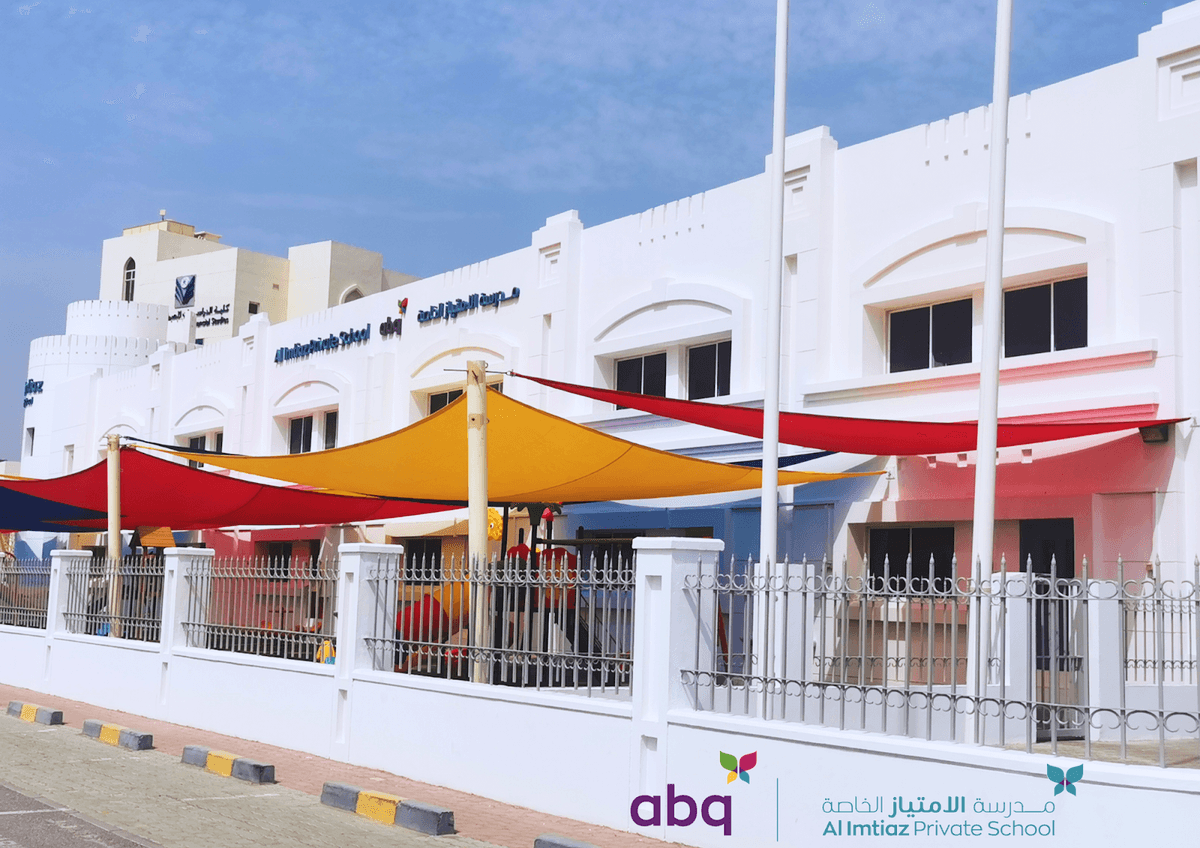
| ABQ Al Imtiaz Private School | Muscat | Bilingual private | Mid-range |
| Beech Hall School Oman | Al Khoudh, Muscat | UK + bilingual elements | Mid-range |
Bilingual Schools Outside Muscat
The non-capital market is smaller but growing. Sohar International School (SIS) is the only Cambridge-accredited bilingual school in Sohar besides ABQ Sohar. Future Pioneers Private School serves the Nizwa region. Several bilingual schools in Barka, Salalah, and other governorates run fees of OMR 1,000–3,000 annually, matching local income levels.
How Much Do Bilingual Schools in Oman Cost?
Annual tuition at bilingual schools in Oman ranges from approximately OMR 1,500 to OMR 5,500. The Sultan's School and Al Sahwa Schools sit at the top of the segment, reaching OMR 4,700–5,420 at Grade 12. ABQ Group schools and KGIS occupy the premium-mid band. Al Injaz, Al Raneem, and United Private School deliver bilingual education for under OMR 3,500 even at Sixth Form.
Fees scale gently across grades in this segment — a notable contrast to international schools where Sixth Form fees can be more than double primary fees.
Bilingual School Fees Comparison Table 2025/26
| School | Location | KG (OMR/year) | Primary (OMR/year) | Grade 11–12 (OMR/year) |
|---|---|---|---|---|
| The Sultan's School | Seeb | 2,690 | ~3,800 | 5,420 |
| Al Sahwa Schools | Madinat Qaboos | 2,160 | ~3,200 | 4,700 |
| ABQ Azzan Bin Qais | Madinat Qaboos | 2,150 | ~3,200 | 4,950 |
| Knowledge Gate International (KGIS) | Al Hail | 2,904 | ~4,000 | 5,893 |
| Muscat International School (MIS) | Qurum | ~2,400 | ~3,500 | ~4,800 |
| Al Injaz Private School | Seeb | 1,822 | ~2,500 | 3,322 |
| Al Raneem Private School | Seeb | 1,628 | ~2,200 | 3,020 |
| United Private School (Athaiba) | Athaiba | 1,500 | ~2,200 | 3,140 |
Sources: Edarabia 2026 Oman fees directory, school websites, and the International Schools Database.
Why Bilingual School Fees Vary So Much
Five drivers explain the OMR 1,500–5,500 range. International accreditation (CIS, COBIS, IB authorisation) each add recurring cost. Proportion of expatriate teachers versus locally-recruited Omani staff shifts payroll significantly. Campus scale and facilities — labs, sports complexes, theatres — drive infrastructure overhead. Curriculum complexity affects cost too: full IB delivery costs more than Cambridge IGCSE, which costs more than basic Omani GED with English supplementation. Finally, brand positioning and parent willingness to pay set the ceiling.
The Sultan's School and Al Sahwa charge premium fees because they hold multiple accreditations and recruit teachers internationally. Al Injaz and Al Raneem keep fees lower through smaller campuses, primarily Omani staff, and tighter facilities.
Additional Fees Parents Should Budget For
The bilingual segment is generally more transparent on fees than the international school segment, with most schools listing costs openly on their websites. Standard add-ons:
- Registration / admission fee: OMR 100–300 one-time, non-refundable
- Annual re-registration fee: OMR 50–200 to reserve next year's seat (Al Sahwa charges OMR 200)
- Refundable deposit: OMR 50–200
- Books and stationery: OMR 100–300 per year
- Uniforms: OMR 80–250 per year
- Transport: OMR 250–600 per year depending on route
- IB or Cambridge exam fees (Al Sahwa, Sultan's, ABQ): payable in Grades 10, 11, and 12
The bilingual segment is the only one in Oman where fee value compounds as the child progresses through grades. International school fees jump 80–120% between primary and Sixth Form (e.g. British School Muscat goes from OMR 3,800 in FS1 to OMR 9,200 in Year 13). Bilingual school fees rise only 50–70% across the same span (Al Sahwa: OMR 2,160 KG to OMR 4,700 Grade 12). For an Omani family with two children attending Al Sahwa from KG to Grade 12, the total cumulative cost saving versus a comparable international school is OMR 50,000–80,000 per child over the 14-year journey, without losing access to global universities. This compounding effect rarely surfaces in side-by-side fee comparisons that show only single-year snapshots.
School fees in Oman complete guide
What's the Quality of Bilingual Schools in Oman?
Quality varies significantly across the bilingual segment. Top-tier schools (Sultan's, Al Sahwa, the three ABQ campuses, KGIS) hold international accreditation through CIS, COBIS, or IB authorisation. The Omani Ministry of Education's Private Schools Evaluation Office has been publishing official inspection ratings since 2018, creating the first standardised quality benchmark across the private sector.
Below the top tier, quality drops fast. A school marketed as "bilingual + Cambridge" without external accreditation may deliver weaker outcomes than its name suggests.
The MoE Private School Rating System
Established 2018 under the Ministry of Education, the Private Schools Evaluation Office inspects schools against national standards covering teaching quality, leadership, student outcomes, facilities, and Arabic / Islamic education delivery. Ratings are published on the Ministry of Education's classification portal.
The framework was reinforced under Royal Decree 31/2023 (the School Education Law), which set out the current legal structure for private school inspection and licensing. Schools that fail to meet minimum Arabic and Islamic Studies hours risk MoE penalties under this decree.
Cross-check the MoE rating against any school's marketed claims before paying registration fees.
International Accreditations Held by Top Bilingual Schools
The accreditations that genuinely matter in this segment:
- CIS (Council of International Schools): Al Sahwa Schools, The Sultan's School, ABQ Azzan Bin Qais (since June 2024), ABQ Seeb, ABQ Sohar
- COBIS (Council of British International Schools): ABQ Education Group schools — the only Omani schools holding this status
- IB World School authorisation: Al Sahwa Schools, The Sultan's School (DP)
- Cambridge International School accreditation: ABQ Group, Al Sahwa (Cambridge stream), MIS, Al Injaz, KGIS, Sohar International School
- BSME (British Schools in the Middle East): ABQ Group
Schools holding two or more accreditations are systematically inspected by external bodies on rotating cycles. This consistency is the single best quality signal in the segment.
Which Bilingual School Is Right for Your Child? Six Decision Factors
- Arabic language strength. Look for "Arabic A" or first-language Arabic delivery, not "second-language" status, if your child is a native Arabic speaker. This determines whether your child leaves school genuinely literate in Arabic.
- Curriculum exit point. Some bilingual schools stop at Cambridge IGCSE; others continue to A-Levels, IB Diploma, or the Omani GED. Know your child's intended university pathway before committing.
- Gender segregation in secondary years. Some bilingual schools segregate boys and girls from Grade 5 onward (matching the public school model). Others remain fully co-educational through Grade 12. Confirm at interview if this matters to your family.
- Class size. Premium bilingual schools target 20–25 per class. Mid-tier schools often run 25–35. Ask for actual current class size, not the marketed target.
- University destinations of recent graduates. Strong bilingual schools publish graduate placement lists covering Sultan Qaboos University, Omani private universities, GCC universities, and UK/US institutions. Compare the last three years, not single-year highlights.
- MoE rating cross-checked with international accreditation overlap. A school with both a strong MoE rating and CIS or IB accreditation is the safest quality signal in the segment.
Are Bilingual School Qualifications Recognised by Universities?
Yes. Qualifications from bilingual schools in Oman are recognised by Sultan Qaboos University, all Omani private and government universities, and every GCC university. Bilingual schools offering Cambridge IGCSE, A-Levels, or IB Diploma additionally hold full recognition with UK, US, Canadian, and Australian universities. The dual qualification structure — international exam + Omani GED — opens up both Omani-medium and English-medium university pathways.
Recognition by Sultan Qaboos University and Omani Universities
The bilingual school advantage at SQU is real:
- Omani GED (General Education Diploma): Direct admission pathway to Sultan Qaboos University and all Omani government and private universities
- Cambridge IGCSE + A-Level: Accepted via Omani Ministry of Higher Education equivalency
- IB Diploma: Accepted directly with attested transcripts
Students from purely English-medium international schools cannot enrol in Sultan Qaboos University's Arabic-medium programs — including law (College of Law), Sharia, Arabic Language and Literature, and Islamic Studies — because they lack academic-level Arabic. Bilingual school graduates can. This effectively doubles the number of SQU programs accessible to bilingual school students compared to international school students. For Omani families considering law or Islamic Studies as a potential career path, this is one of the strongest practical reasons to choose a bilingual school over an international school. Most parent guides treat SQU as a single destination without breaking down which programs each curriculum opens or closes.
Recognition by GCC, UK, and Other International Universities
The non-Omani recognition picture is straightforward for bilingual school graduates holding Cambridge or IB qualifications:
- GCC universities (Saudi Arabia, UAE, Qatar, Kuwait, Bahrain): All recognise Cambridge IGCSE, A-Levels, IB Diploma, and the Omani GED
- UK universities: Direct undergraduate entry for A-Level and IB Diploma holders; UCAS treats them on the same scale as UK domestic applicants
- Egypt, Jordan, and Lebanese universities: Accept the Omani GED via Arab League equivalency frameworks
- US and Canadian universities: Accept Cambridge A-Levels and IB Diploma with SAT/ACT scores; many award course credit for HL or A-Level subjects
How Do Bilingual School Admissions Work in Oman?
Each bilingual school manages its own admissions independently. There is no centralised portal as exists for Indian schools. Top bilingual schools (Sultan's, Al Sahwa, the ABQ campuses) maintain waiting lists for popular year groups. Most accept applications 3–9 months ahead of the August intake.
Typical Admission Process
The standard sequence across most bilingual schools in Oman:
- Online application via the school's website
- Application / assessment fee: OMR 30–150 (non-refundable)
- Previous school reports (last two years)
- Passport copies and resident card / Omani national ID
- Vaccination and health records
- Entrance assessment: literacy and numeracy testing in both Arabic and English, particularly for Arabic-speaking students
- Parent interview, especially for younger grades and Grade 11 entry
- For Grade 11 entry: Grade 10 results or predicted grades plus a reference from the previous school
The Arabic-component of entrance assessments is a critical filter that doesn't exist at international schools. If a child has been at an international school where Arabic was a weak subject, they may need supplementary Arabic preparation before transferring into a bilingual school in middle or secondary years.
When to Apply
Standard timelines for the August intake:
- Premium tier (Sultan's, Al Sahwa, the three ABQ campuses): Apply October to February for the following August intake. Waiting lists are real, particularly for KG, Grade 1, and Grade 7 entry.
- Mid-tier schools (Al Injaz, Al Raneem, United, KGIS): Apply by April to May for August intake. Some spaces may remain open into June.
- Mid-year transfers: Possible at most grade levels except Grade 12, where Cambridge and IB exam board registration deadlines effectively block late entry.
Bilingual vs International vs Public Schools in Oman — Which to Choose?
Bilingual schools fit families who want strong English education without losing Arabic fluency, Islamic education, and Omani cultural grounding. They cost less than premium international schools and provide equivalent international qualifications. Choose international schools (BSM, TAISM, ABA) if global mobility and Western university entry are the top priority. Choose public schools if cost is the primary driver and you accept Arabic-medium delivery.
| Factor | Bilingual Schools | International Schools | Public Schools |
|---|---|---|---|
| Annual fee (top grade) | OMR 3,000–5,500 | OMR 7,500–10,270 | Free for Omani citizens (50% subsidised for expats) |
| Language of instruction | Arabic + English (true bilingual) | English primary, Arabic mandatory but compressed | Arabic primary, English as subject |
| Arabic strength | Strong (first-language standard) | Variable, often weak | Native level |
| University pathways | SQU + Omani universities + GCC + UK/US (via IGCSE/IB) | UK, US, Australia prioritised; SQU English-medium programs only | SQU + Omani universities |
| Best for | Omani families seeking English fluency plus identity preservation; Arab expat families | Globally mobile expat families; Omani families targeting Western universities exclusively | Omani families on budget; strong cultural alignment |
| Top schools | The Sultan's School, Al Sahwa, ABQ Group, KGIS, MIS | BSM, TAISM, ABA, Cheltenham, Downe House | Government schools |
A practical frame: bilingual schools optimise for Omani identity + global qualifications, international schools optimise for global mobility and Western university entry, and public schools optimise for cost and full cultural alignment. The right choice depends on the family's long-term plan and the child's likely university destination.
Bilingual Schools by City in Oman
Bilingual Schools in Muscat
The capital concentrates the country's strongest bilingual schools. Major options include The Sultan's School (Seeb), Al Sahwa Schools (Madinat Qaboos), ABQ Azzan Bin Qais International (Madinat Qaboos), ABQ Seeb International School (Seeb), Knowledge Gate International School (Al Hail), Muscat International School (Qurum), Al Injaz Private School (Seeb), Beech Hall School Oman (Al Khoudh), and A'soud Global School (Al Khoudh). See all bilingual schools in Muscat
Bilingual Schools in Sohar
ABQ Sohar International School is the largest international / bilingual school in the Al Batinah region, with strong Cambridge results consistently. Sohar International School (SIS) is the only Cambridge-accredited bilingual school in Sohar outside ABQ. Both serve the industrial expat community and an increasing share of Omani families. See all schools in Sohar
Bilingual Schools in Salalah, Nizwa, Barka, and Other Regions
Lower-fee bilingual schools dominate the regional market, with average fees of OMR 1,000–3,000. Future Pioneers Private School in Nizwa and several bilingual schools in Barka, Salalah, and Sur serve local Omani and Arab expat communities. Most follow Cambridge Primary or Edexcel frameworks combined with the Omani national curriculum. All schools in Salalah · All schools in Nizwa